Brosisincorp Wall Wood Plank Panels for Real Results
These shiplap-style planks are actual wood — Paulownia and pine — not vinyl sheeting with a printed grain. They come in peel-and-stick and nail-up formats depending on how permanent you want the installation, and three finishes that work across modern farmhouse, rustic, and Scandinavian-adjacent interiors. Each box covers between 11 and 12.4 square feet, so a single accent wall is a weekend project, not a contractor call.

All Three Panel Options in This Line
Shiplap Peel-Stick Panel Multi
See on Amazon
Shiplap Peel-Stick Panel Light
See on Amazon
Barn Wood Nail-Up Plank
See on AmazonPanel Specs Side by Side
These three panels cover different installation methods, substrates, and finishes — the table below puts the key specs in one place so you can compare directly.
| Model | Plank Size (L × W) | Thickness | Packs / Coverage | Weight per Box | Installation | Finish | Best For |
|---|---|---|---|---|---|---|---|
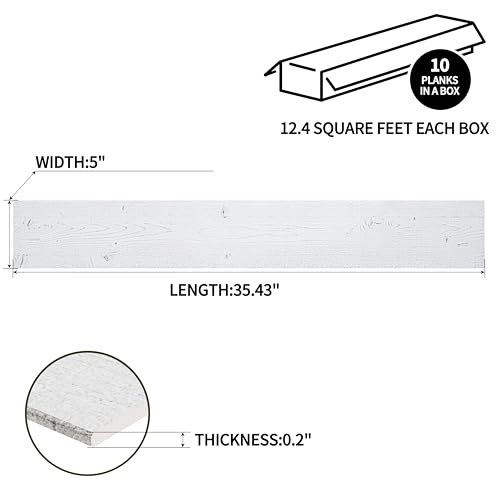
| Real Wood Shiplap White (B0C1MJR8J4) | 35.43" × 5.04" | 0.2" | 10 planks / 12.4 sq ft | 3.84 lbs | Peel and stick | Bright white | Bedroom accent wall, clean modern look, rental-friendly install |
| Wash White Pine (B0BLCMQKRP) | 35.43" × 5" | Not specified | 10 planks / 12.4 sq ft | 5.51 lbs | Peel and stick | Wash white with visible pine grain | Rustic or farmhouse accent wall, living room or dining room feature |
| Nail Up Off White Barn (B0CJMC89LV) | 48" × 5.5" | 0.31" | 6 planks / 11 sq ft | Not specified | Nail up | Off white, reclaimed barn wood look | Permanent installs, entryways, full-room paneling, imperfect surfaces |
If the install needs to be reversible, choose either peel-and-stick option; if it's a permanent wall in a space with humidity variation or heavier use, the nail-up Off White panel's added thickness and mechanical fastening make it the more durable long-term choice.
How to Choose Between These Three Panels
The first decision is installation method. Two panels in this line use a peel-and-stick adhesive backing — you prep the wall, peel, press, and trim with a utility knife. The third, the Off White Nail Up panel, goes up with finishing nails or a brad nailer. Peel-and-stick is better for renters, accent walls in low-humidity rooms, and anyone who wants to avoid putting holes in walls. Nail-up is better for permanent installs, higher-traffic spaces, or walls where you're less confident in the adhesive bond — unprimed, textured, or slightly damp surfaces.
The second decision is plank size and coverage. The two peel-and-stick options measure 35.43" × 5" per plank, with 10 planks covering 12.4 square feet per box. The nail-up Off White panel runs larger: 48" × 5.5" per plank, 6 planks per box, covering 11 square feet. The longer format means fewer seams on a wide wall, which reads as more seamless from across the room — a meaningful visual difference on walls wider than 8 feet.
The third decision is finish. The two peel-and-stick options offer different white treatments:
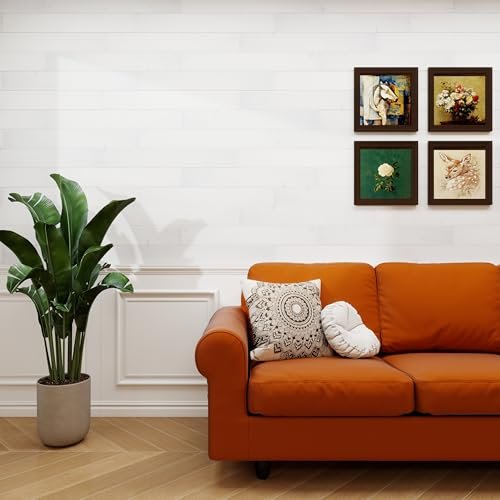
- Standard White (B0C1MJR8J4): A cleaner, brighter white — closer to a painted finish — with a slightly lighter weight (3.84 lbs per box).
- Wash White — Pine (B0BLCMQKRP): A washed, grain-forward finish on natural pine that reads as more rustic and textured; slightly heavier at 5.51 lbs per box, which reflects the denser pine substrate.
- Off White — Nail Up (B0CJMC89LV): A warmer, reclaimed-barn-wood look with a 0.31" thickness — meaningfully thicker than the 0.2" peel-and-stick planks — which gives the wall a more substantial, three-dimensional shadow line between courses.
If you're building a permanent feature wall and want the deepest grain shadow, go nail-up. If you want clean, bright white with the easiest install, go with the standard peel-and-stick. If you want visible wood grain and a warmer tone without nails, the Wash White pine is the middle option.
Real-World Installs and Where Each Panel Fits
Before ordering, calculate your coverage needs using this formula: (wall height in feet × wall width in feet × 1.05 for cut waste) ÷ 12.4 for peel-and-stick boxes, or ÷ 11 for nail-up boxes. A standard 8-foot by 10-foot accent wall needs roughly 80 square feet of coverage before the cut-waste buffer — that's approximately 7 boxes of either peel-and-stick option, or 8 boxes of the nail-up. Rounding up is the right move; running short mid-install is a worse problem than having one box left over.
The peel-and-stick panels are well-suited to these specific scenarios:
- Bedroom headboard walls: Low humidity, low impact — ideal conditions for adhesive-backed planks. The standard white and wash white finishes both work here against linen or neutral bedding.
- Living room or dining room accent walls: One wall behind a sofa or credenza. The 35.43" plank length means a standard 9-foot-wide wall needs roughly three planks per row, with minimal cuts.
- Rental apartments: The peel-and-stick format is removable in most cases — but surface prep matters. Apply to clean, primed drywall and the bond is strong; apply to wallpaper or unprimed texture and removal becomes unpredictable.
The nail-up Off White plank is the better choice for:
- Mudrooms or entryways: Higher humidity variation and more physical contact than a bedroom wall. The added thickness (0.31") and mechanical fastening mean the planks won't shift or peel at the edges over time.
- Full-room installations: If you're paneling all four walls rather than just one, nail-up gives you a more consistent, intentional result — and the longer 48" plank reduces the number of seams in a full-room layout.
- Walls with imperfect surfaces: Nail-up tolerates uneven or slightly textured drywall better than adhesive, since you're not relying on full-surface contact for holding power.
Installation, Surface Prep, and Common Mistakes
For peel-and-stick panels, the wall surface is the primary variable. Clean, dry, smooth, primed drywall gives the adhesive the best contact surface. Wipe the wall down and let it dry fully before you start. If the wall is unprimed, apply a coat of primer and let it cure for 24 hours — the adhesive sticks to the primer, not to raw drywall compound or texture. Skipping this step is the most common reason planks start lifting at the corners within weeks.
Installation sequence for peel-and-stick:
- Start from the bottom of the wall and work upward — it's easier to maintain level rows this way, and a laser level or chalk line saves time over measuring each course individually.
- Each plank can be cut with a utility knife and a straight edge — score deeply along the cut line, then snap. No saw required.
- Press firmly along the full length of each plank after placing it, not just at the ends. Edge-lifting almost always starts where the center didn't get full pressure contact.
- For heavier applications or walls that aren't perfectly smooth, add finishing nails at the plank ends as a supplement to the adhesive. This is not a failure of the adhesive — it's standard practice for any wall covering in a higher-humidity or higher-traffic location.
For the nail-up Off White planks, use 1.5" to 2" finishing nails or brad nails driven through the face or tongue of each plank into the studs. Locate your studs before you start and mark them lightly with tape — the 48" plank length will span multiple studs, and anchoring at each stud point is what keeps the panel flat and prevents bowing over time. Because these planks are 0.31" thick, they can also be applied directly over existing drywall without the wall looking built-out by an awkward amount.
Frequently Asked Questions
Are these actually real wood, or is the wood grain printed on vinyl?
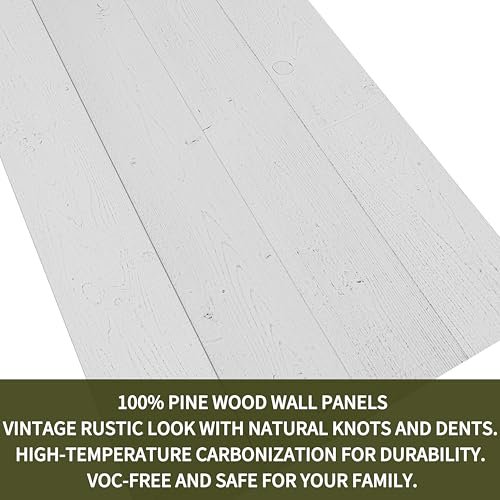
These are real wood planks — not vinyl, not PVC, not a wood-printed film with a foam backing. The peel-and-stick options are real Paulownia-based and pine wood planks with an adhesive backing applied; the nail-up option is a thicker reclaimed-barn-style real wood panel. The distinction matters in practice: real wood can be cut cleanly with a utility knife along the grain, takes paint and stain, and has natural variation plank to plank. Vinyl alternatives flex, print uniformly, and behave completely differently at the cut edge.
Will peel-and-stick planks actually stay on the wall, or will they start peeling within a few months?
On a properly prepped wall — clean, dry, smooth, primed drywall — the adhesive holds reliably. The most common failure mode is skipping surface prep: applying directly to unprimed drywall, over existing wallpaper, or onto a textured or slightly damp surface gives the adhesive a compromised contact surface and the edges will lift. For extra insurance in kitchens, bathrooms, or entryways, supplement the adhesive with finishing nails at the ends of each plank. That combination handles humidity variation and light physical contact without any edge-lift over time.
How many boxes do I need for a standard accent wall?
Use this formula: multiply wall height (feet) by wall width (feet), then multiply by 1.05 to account for cut waste, then divide by 12.4 for peel-and-stick boxes or 11 for nail-up boxes. A common 8' × 10' accent wall comes out to roughly 6.8 peel-and-stick boxes — round up to 7. A 9' × 12' wall needs about 8.2 boxes — round up to 9. Always round up; finishing the wall a plank short mid-install is harder to solve than having leftover planks.
Can I paint or stain these planks after installation?
Yes. Because these are real wood, they accept paint and stain the way any wood surface does. For peel-and-stick planks in the white finish, a light scuff sand with 220-grit and a coat of primer gives paint better adhesion. The Wash White pine finish has an existing treatment that may need a light sanding to fully accept a new stain color. The nail-up Off White barn planks can be painted directly once installed and nailed flush.
What's the difference between the two peel-and-stick white options?
The standard White (B0C1MJR8J4) is a brighter, cleaner white — closer to a painted wall finish — and comes in at 3.84 lbs per box, making it the lightest option to handle and install. The Wash White Pine (B0BLCMQKRP) uses a natural pine substrate with a washed white treatment that lets the grain show through — it reads as warmer and more textured, especially under directional lighting. It weighs 5.51 lbs per box, which reflects the denser pine. If you want a contemporary, crisp look, go standard white. If you want a visible-grain rustic farmhouse feel, go wash white.
Can the nail-up planks go over existing drywall without looking too built out?
Yes. At 0.31" thick, the nail-up Off White planks add less than a third of an inch of depth to the wall surface — about the same as a typical baseboard paint buildup. That's not enough to create a noticeable step at electrical outlets or window casings in most cases. For outlets, you may need outlet extender plates to bring the face plate flush with the new wall surface — standard hardware store accessories that cost a few dollars each.